

June: Blooming
"And the day came when the risk to remain tight in a bud was more painful than the risk it took to blossom." - Anais Nin
Welcome to June, and welcome to month six of our year-long journey: Grow with the Flow.
You have done a tremendous amount of work to get here. In January, you asked who you are becoming. You planted a seed of intention and began the practice of honest self-inquiry. In February, you recognized that you do not become alone. You grew in relationship, held by the people who love you and the community here at South River. In March, you practiced seeing clearly, trusting your inner knowing, and speaking your truth. In April, you went deep. You built a foundation, established discipline, and put your roots down. In May, you asked what actually feeds you, and you began the practice of nourishing yourself with genuine care.
Now, in June, something is ready to come through.
You have the intention. You have the relationships. You have clarity, roots, and nourishment. The conditions for blooming are in place. The question now is whether you are willing to let it happen.
What does it look like when I actually blossom? What wants to come through me, if I stop holding it back?
This is not a month to push or force. Blooms do not open through effort. They open because the conditions are right and the flower trusts the process. June is an invitation to trust yours.
Welcome to Blooming. Welcome to the practice of letting yourself be seen.
-
Blooming is not an achievement. It is not something you make happen. It is what naturally emerges when the right conditions are present and you stop getting in the way.
Think about a flower. It does not strain to open. It does not compare itself to the flower next to it, or wait until conditions are perfect. It opens because it is ready, because it has been rooted and nourished, and because that is what flowers do.
You have spent five months getting ready. This is the month to open.
Blooming this month means:
Expressing: Allowing what is true and alive in you to come outward, into speech, into action, into creative work, into the way you show up in your own life.
Trusting: Believing that what you have to offer is worth offering, without waiting for permission or the perfect moment.
Receiving: Letting people actually see you. This is harder than it sounds, and it is its own practice.
Contentment: Blooming from exactly where you are, not from where you think you should be. The flower does not wait for a better garden.
Space: Creating enough openness in your life that something new can emerge. You cannot bloom in a space that is completely full.
For many of us, blooming is the part that feels risky. The roots were private. The nourishment was internal. Blooming is when the inside becomes visible. That takes a different kind of courage than anything we have done so far this year.
This month, we practice that courage. Not loudly, not all at once. One petal at a time.
-
The arc of this year is not random. Each month builds on the one before it, like a plant growing in stages.
- January (Becoming): Who am I becoming? We plant the seed of intention.
- February (Connecting): Who supports my becoming? We recognize we grow in relationship.
- March (Clarifying): What do I see as my path forward? We gain clarity about our direction.
- April (Rooting): How do I ground myself? We establish the foundation that will support all future growth.
- May (Nourishing): What feeds my growth? We learn to tend to ourselves with genuine care.
- June (Blooming): What does it look like when I blossom? We embrace the opening of our truest expression.
- July (Thriving): How do I sustain this aliveness? We learn to channel our energy with wisdom.
Here is why June follows May so directly: you cannot bloom from a depleted place. Everything you did in May, the nourishing, the tending, the honest look at what feeds you and what drains you, was preparation for this. A flower that has been well-watered and well-rooted does not resist opening. It just opens.
You have been well-watered. You have roots. June is the opening.
-
Winter (Jan-Mar): Becoming, Connecting, Clarifying - We awaken and orient ourselves
Spring (Apr-Jun): Rooting, Nourishing, Flourishing - We establish and grow
Summer (Jul-Aug): Thriving, Flowing - We express and surrender
Fall (Sep-Nov): Grounding, Releasing, Harvesting - We transition and gather
Winter (Dec): Stilling - We rest and integrate
-
Grounded to Grow: A Live Sound and Restorative Yoga Workshop
Friday, June 26th | 6pm - 8pm
What does it look like when I actually blossom?
I bloom from where I am.
Carry this with you throughout June. Say it in the morning before your feet hit the floor. Return to it when you feel yourself waiting to be ready, or holding back until conditions improve. Four words. The whole practice of Santosha, right there.
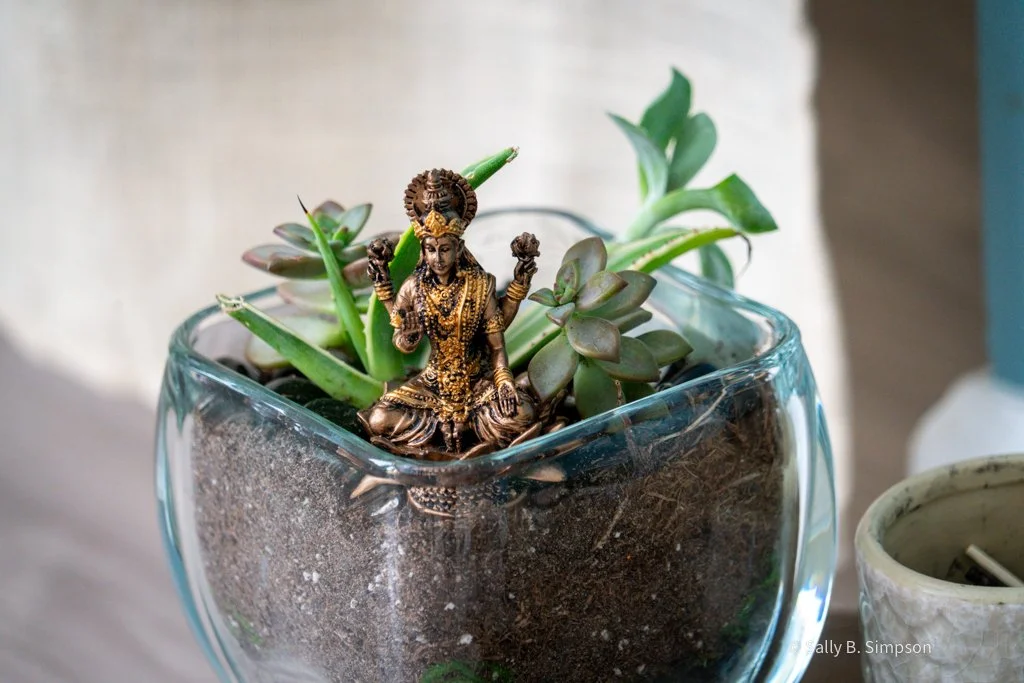
Yoga Philosophy: The Foundation of Theme
Every concept this month points toward the same truth: you already have something worth expressing. The work is creating the conditions for it to come through.
Building on Previous Months
In January, you practiced Svadhyaya, the honest inquiry into who you are becoming. In February, you practiced Ahimsa, bringing compassion to yourself and your relationships. In March, you practiced Satya, learning to see and speak what is true. In April, you practiced Tapas, building the consistent discipline that creates a strong foundation. In May, you practiced Saucha, discerning what to take in and what to let go.
Now in June, all of that inner work is ready to come outward. You have studied yourself, connected with others, clarified your vision, built your foundation, and tended your fire. The only thing left is to bloom.
The shift to June:
January: Who am I becoming?
February: Who supports me?
March: What do I see clearly?
April: What ground am I standing on?
May: What feeds all of this?
June: What is ready to come through me?
Vishuddha Chakra (Throat Chakra)
Vishuddha (Sanskrit: Vishuddha Chakra, from vish meaning impurity and uddha meaning purification) is the fifth chakra, located at the throat and neck. Its element is Akasha (space and ether), its color is sky blue, its associated sense is sound, and its bija mantra is HAM. The name itself tells you something important: this is not just the center of speech, it is the place where what we carry inside us gets purified and clarified before it comes out. It governs everything related to expression: speaking, listening, singing, writing, teaching, and any act of communication that carries your authentic self outward into the world.
This chakra is not just about talking. It is about the alignment between what is true inside you and what you allow to come out. When Vishuddha is open and healthy, there is very little gap between who you are and how you show up. What you think, feel, and believe is reflected clearly in how you communicate and how you live.
The Vishuddha quality most relevant to Blooming is this: the willingness to be heard. Not the performance of confidence, but the actual act of allowing your truth to come through, in your voice, your work, your choices, the way you take up space in a room.
Qualities of Balanced Vishuddha:
Speaking honestly and with care, even when it is uncomfortable
Listening as fully as you speak
Creative expression that flows naturally, without needing to be perfect first
A felt sense that your outer life reflects your inner truth
Ease with silence as well as with being heard
Saying what you mean without dressing it up or softening it into something unrecognizable
Signs of Imbalanced Vishuddha:
Holding back what you want to say to keep the peace
Talking a great deal without saying anything real
Fear of being seen, heard, or misunderstood
A persistent feeling that no one really knows you
Chronic throat tightness, tension in the neck and jaw, or difficulty swallowing
Creative ideas that live only in your head, never making it out into the world
How It Connects to This Month:
Blooming is a Vishuddha act. It is the moment when what has been growing inside you becomes visible. This month is about closing the gap between your inner life and your outer expression. Not perfectly. Not all at once. But honestly, and more than before.
On the Mat:
In every backbend, feel your chest and throat opening. That is an invitation for Vishuddha to soften and expand.
Notice where you hold tension in your neck, jaw, and shoulders. These are the places where unexpressed things tend to live in the body.
Try humming softly on your exhales during practice, even for just 30 seconds. Feel the vibration in your throat and chest. That is Vishuddha being gently activated.
When your teacher cues you to breathe, let your exhale be audible. Let yourself take up a little sonic space in the room. That is not an interruption. It is the practice.
Off the Mat:
Notice this month how often you edit yourself before speaking. How much of what you say is what you actually mean, and how much is a safer version of it?
Practice one honest expression each day: something small you might normally swallow. A real answer when someone asks how you are. A genuine compliment, spoken plainly. A need stated without apology.
Try writing something this month with no audience in mind. A journal entry, a letter you never send, a few lines of something you keep entirely to yourself. Expression without performance is pure Vishuddha practice. Notice how different it feels when there is no one to impress.
Pay attention to how you feel after conversations this month. Did you say what you actually meant, or a careful version of it? Did you listen fully, or wait for your turn to talk? Vishuddha governs both ends of communication, and the quality of your listening is as much a reflection of this chakra as the quality of your speech.
Akasha (Space / Ether)
Akasha (Sanskrit for space, sky, and ether) is the most subtle of the five great elements (Pancha Mahabhutas): space, air, fire, water, and earth. It is Vishuddha's element, and its sense is sound. The pairing makes perfect sense: before sound can travel, there must be space for it to move through. Openness, expansiveness, receptivity, the capacity to hold: these are Akasha's essential qualities. It is the element that contains all the others. Without space, nothing can exist, move, or be heard.
This is not emptiness. Akasha is not nothing. It is the quality of openness that makes everything else possible. A room with no space cannot hold anything new. A schedule with no space cannot hold rest. A mind with no space cannot hear itself think. And a life with no space cannot hold a bloom.
In the yogic tradition, Akasha is associated with sound. Before sound can travel, it needs space to move through. This is why Akasha and Vishuddha belong together. Your voice, your expression, your truth: these need space to travel. They need room in your life and room inside you.
Akasha in Your Life:
Most of us are running at capacity. Our schedules are full, our minds are full, our inboxes are full, our homes are full. We have very little Akasha. And then we wonder why nothing new seems to be growing.
Blooming requires space. Not a lot. But some. The flower does not need a perfect garden, but it does need room to open.
This month, the practice of Akasha is simply noticing where there is room and where there is not, and making one small clearing.
On the Mat:
Between poses, rest for a full breath before moving. Give your nervous system some Akasha.
In Savasana, instead of planning your day, practice resting in pure open awareness. Nothing to do, nowhere to go. Just space.
Notice the quality of the room itself. The space around your body. The space between your breath and the next movement. Yoga is not just about what your body does. It is also about learning to inhabit the space around you.
Off the Mat:
Create some physical space in your environment this month. Clear a surface. Open a window. Donate something you no longer need. Notice what arrives when you do.
Identify one place in your life this month that needs more space: one commitment you could release, one evening you could leave unscheduled, one relationship where you need more breathing room.
Practice doing less in a single moment. Put your phone down and sit for five minutes with no input, no task, no production. That is Akasha practice. It will feel uncomfortable before it feels good.
Notice what arrives in the space. Ideas, rest, memories, creativity. What blooms in you when there is room for it?
Santosha (Contentment)
Yoga Sutra 2.42: Santosha anuttamah sukha labhah
"By contentment, supreme joy is gained.” -- Swami Satchidananda, The Yoga Sutras of Patanjali
Santosha (Sanskrit: sam meaning completely, tosha meaning contentment and acceptance) is the second Niyama in Patanjali's Yoga Sutras. It is one of the most quietly radical practices in all of yoga. In a world that runs on the premise that you should always want more, do more, and be further along than you are, Santosha asks a different question: what if this were enough?
This is not giving up. Santosha is not resignation or pretending things are fine when they are not. It is the practice of finding genuine peace with where you actually are, without requiring circumstances to be different before you allow yourself to fully show up and bloom.
Here is why this matters for June: most of us are waiting to bloom. We are waiting until we lose the weight, finish the degree, fix the relationship, get the promotion, or reach whatever finish line we have set before we will allow ourselves to open fully. Santosha says: the waiting is the problem. You can bloom right here, from this. The flower does not wait for a better garden.
What the Sutra Is Saying:
Patanjali is not promising that contentment will make your life easy or problem-free. He is saying something more interesting: that the practice of contentment itself generates a quality of joy that nothing external can provide or take away. Anuttamah. Unsurpassed. The highest possible.
Most of us have it backwards. We think: when things improve, I will feel content. Patanjali is saying: practice contentment first, and a joy you have never found through achievement becomes available.
That is the invitation this month. Not to pretend everything is fine. But to practice finding the thread of enough, of right here, of genuinely okay, even while acknowledging what is hard or incomplete.
On the Mat:
When you find yourself straining toward a version of the pose you think you should be in, pause. Find what is available today. Practice being exactly where you are, and treating that as enough.
Notice the difference between effort that feels alive and purposeful versus effort that feels like punishment. Santosha asks you to find the former and gently release the latter.
At the end of class, before you roll up your mat, take one full breath of genuine appreciation. Not for the perfect practice, but for the one you actually showed up for.
Off the Mat:
Once this month, catch yourself in the "when X happens, then I will feel okay" loop. Write it down. Then ask: what is genuinely good right now, exactly as things stand?
Notice where in your life you are waiting to bloom until conditions improve. What would it look like to open even slightly, right here, from this?
Santosha does not mean staying in situations that genuinely need to change. It means not postponing your own aliveness while you wait for them to.
Udana Vayu (The Upward-Moving Breath)
Udana Vayu (Sanskrit: ud meaning upward, ana meaning breath or life force, vayu meaning wind) is one of the five Vayus (Pancha Vayu), the five distinct movements of prana (life force energy) throughout the body. It is centered at the throat, head, and upper chest, and it moves upward and outward, governing speech, expression, creative output, and the elevation of energy. Prana does not move in one direction. The yogic tradition identifies each Vayu by its region and function:
Prana Vayu: inward and upward, centered at the heart, governing inhalation and reception
Apana Vayu: downward and outward, centered at the pelvis, governing elimination and rooting
Samana Vayu: inward and equalizing, centered at the navel, governing digestion
Vyana Vayu: outward in all directions, governing circulation and integration
Udana Vayu: upward and outward, centered at the throat, governing expression and elevation
Udana is the force behind your voice. It is what carries your thoughts, intentions, and energy upward through the throat and out into the world. When Udana flows freely, your voice carries your truth. Your creative expression comes naturally. You feel a sense of uplift in body and spirit. The energy in your life moves forward and upward.
When Udana is blocked or suppressed, the symptoms are familiar: words swallowed before they can be spoken, ideas that never make it out of your head, a feeling of heaviness or stagnation, creative energy with nowhere to go.
Udana Vayu and Blooming:
A flower opening is the most perfect image of Udana Vayu in nature. The energy that moves upward through the stem, that pushes the bud open, that lifts the petals toward the light: that is Udana. You carry this same movement within you. The question is whether you are allowing it.
Every time you speak your truth, share your work, say yes to visibility, or let something that lives inside you come out into the world, you are working with Udana Vayu. Every time you swallow your words, hide your gifts, or wait until you feel more ready, you are working against it. This month is about practicing the former.
On the Mat:
Begin class by taking three deep breaths and, on each exhale, allow a soft sound: a sigh, a hum, any audible release. Feel the energy moving upward through your throat. That is Udana Vayu being invited to move.
In backbends and heart openers, visualize energy rising from your belly up through your chest and throat and out through the crown of your head. Let the pose be an act of Udana.
Try chanting or sounding the bija mantra HAM (pronounced hum) at the beginning or end of your personal practice. Three times, with full breath behind it. Feel where it lands in your body.
After Savasana, before you speak, notice the quality of your throat. Often it is softer and more open after practice. That is the state to carry into your day.
Off the Mat:
Pay attention this month to the moments when you almost say something, and then don't. What stops you? That hesitation is information about where Udana is being held.
Practice one small act of upward expression each day. Sing in the car. Read something beautiful aloud. Write one true sentence you don't show anyone. The scale doesn't matter. The direction does.
Notice the correlation between movement and expression in your own life. Many people find that after a strong physical practice, it is easier to say what they mean. That is Udana Vayu being freed by the body.
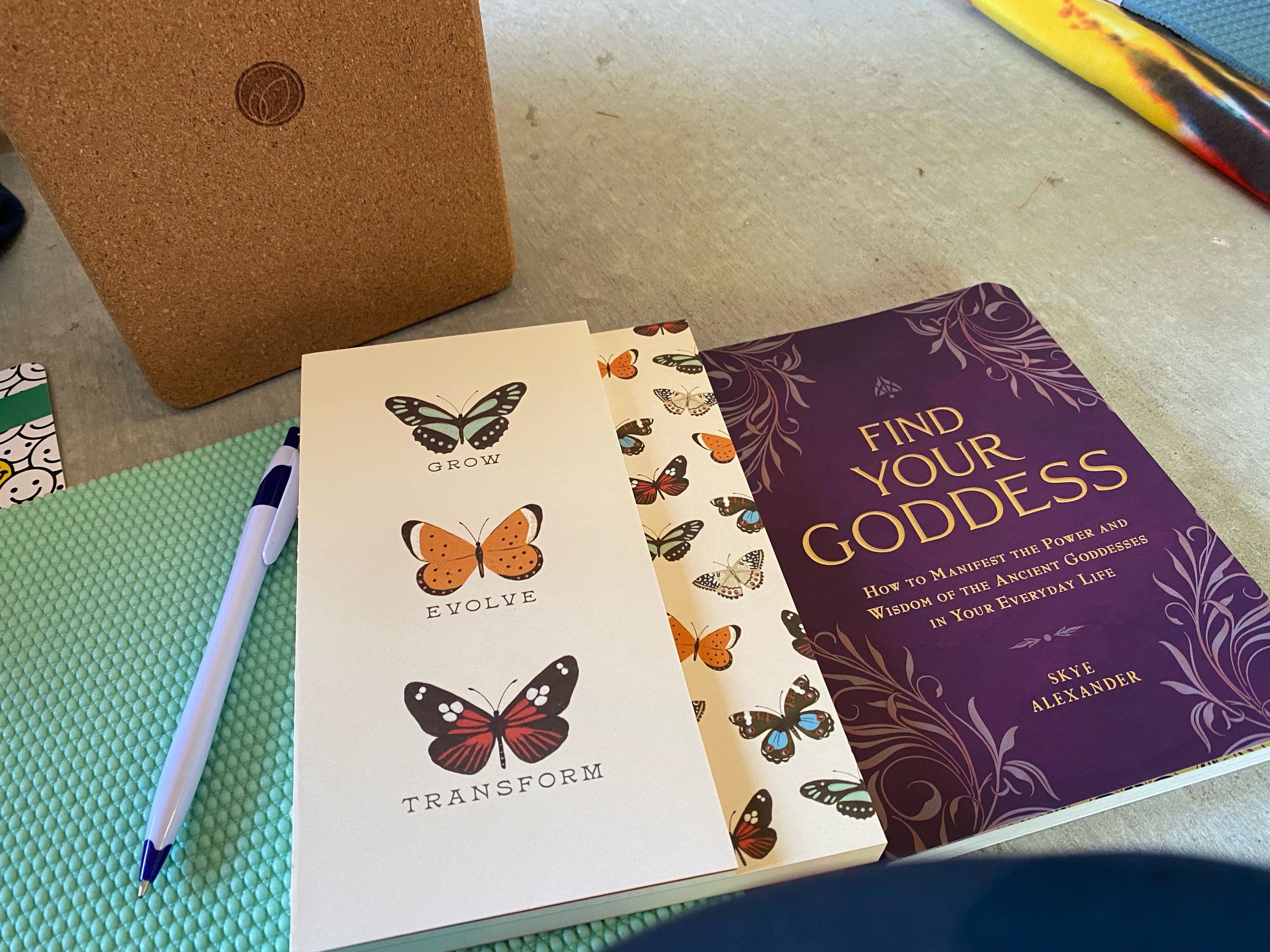
Reflection Prompts for Journaling
Sit with these questions over the course of the month. They are not meant to be answered all at once. Return to them when something stirs.
What Does Blooming Mean for Me?
Where in your life are you most ready to bloom? What has been quietly growing that is ready to come forward?
What are you waiting for before you let yourself fully open? Is that wait necessary, or is it a habit?
When in your life have you felt most fully yourself, most expressed, most visible? What made that possible?
What would it mean to bloom not when conditions are perfect, but right now, from exactly where you are?
Finding My Voice
What do you want to say that you have been holding back? To whom, and why?
Where in your life is there a gap between who you are on the inside and what you show on the outside? What would it take to close it even slightly?
When do you feel most free to express yourself? What conditions create that freedom?
What would you create, say, or share if you were not worried about how it would be received?
Practicing Contentment
1. Make a list of five things that are genuinely good about your life right now, exactly as it is.
2. Where are you waiting to feel content? What is the condition you are waiting for?
3. What would it mean to bloom where you are planted, rather than waiting to be moved somewhere better?
4. What does unsurpassed joy (Sutra II.42) feel like in your body? When have you touched it, and what was present?
What Am I Carrying Into July?
1. What bloomed in me this month, even a little?
2. Where did I let myself be seen that I normally would not have?
3. How did the practice of contentment shift anything for me in June?
4. What one intention, practice, or insight am I carrying into July (Thriving)?
Home Practices to Deepen Into the Theme
Your studio practice is where you build this work in your body. Everything below is designed to support and deepen what you are already doing on the mat. Come to class. The home practices meet you in between.
Morning Practice: Opening for the Day (5-8 minutes)
Before the world starts asking things of you, take a few minutes to let yourself open from the inside out. This practice works with Udana Vayu and Vishuddha to begin each day from an expressed rather than a suppressed place.
Before getting out of bed (1-2 min)
Lie still. Place one hand on your throat and one on your chest. Take three slow, full breaths. On each exhale, make a soft hum. Feel the vibration move through your chest and throat. Do not worry about the sound. The vibration is what matters.
Check in (1-2 min)
With your hands still on your throat and heart, ask yourself: What do I want to express today? What wants to come through me? Do not answer with your planning mind. Let your body answer first. Notice what arises.
Affirmation (1 min)
Before you stand up, say this aloud, or quietly to yourself if others are nearby: This month’s affirmation, “I bloom from where I am.” or ”I have something worth expressing. I trust my voice to carry it." Say it slowly. Let it land before you move on.
Set your expression intention (1 min)
Choose one small, concrete act of expression for today. Not a goal. Something real and specific: saying what you actually think when someone asks your opinion, writing one honest sentence in your journal, speaking up in a moment you would normally stay quiet. Small and true.
Altar Practice: Refreshing Your Grow with the Flow Space for Blooming
Last month, your altar held the warm energy of fire and nourishment. This month, we are opening it up. The energy of June is spacious, expressive, and quietly joyful.
What Stays:
Your candle
Sacred objects that feel meaningful to your practice
The Grow with the Flow graphic
What Changes for June:
Remove or Store:
May nourishing items (yellow and golden objects, warming spices, fire element pieces)
Add for Blooming:
1. Your June Intention:
Write this month's affirmation on paper and place it where you will see it: “I bloom from where I am.”
2. Vishuddha Items (sky blue and spacious):
Something blue: a blue stone such as blue lace agate, aquamarine, or turquoise; or simply a blue cloth or piece of paper
Something that represents your voice or expression: a musical instrument, a pen, a small notebook, a printed image of something you created
Fresh flowers, any kind that is in bloom near you right now
3. Akasha Items (space and openness):
Clear objects that evoke space: a small clear crystal, a glass bowl with water, a white candle
Something light and open: a feather, a piece of sheer fabric, a small mirror
Remove at least one object from your altar that no longer feels necessary. Create space. That act of clearing is itself an Akasha practice.
4. Santosha Items:
Something that represents genuine contentment in your life right now: a photo, a small object from a moment when you felt truly at peace, a note from someone you love
Monthly Altar Ritual (5-10 minutes):
1. Clear: Remove May's fire items with gratitude for the nourishment you received last month.
2. Create space: Before you add anything new, sit with the empty altar for a moment. Let it be bare. This is Akasha. Notice how it feels.
3. Light your candle with intention. This flame now represents Udana Vayu, the energy that rises and seeks expression.
4. Build: Add your June items mindfully, considering what each one represents for your blooming this month.
5. Dedicate: Place one hand on your throat. Feel it soften. State your intention aloud: "This month, I allow what is true in me to come forward. I trust my voice. I make space for what wants to bloom."
Using Your Altar Throughout June:
Daily: Light the candle during your morning practice. Hum briefly at the altar before your day begins.
When you feel creatively blocked: Come to the altar, light the candle, and do the Contentment Pause practice here.
Summer Solstice (June 21): Add one flower to the altar as an act of marking the peak of bloom.
Summer Solstice Practice: Blooming at the Peak | Sunday, June 21st
The Summer Solstice is the longest day of the year. In the natural world, it is the peak of the bloom: the moment of fullest opening before the slow turn back toward stillness begins. It is a powerful day to mark intentionally.
The Practice:
Sometime on June 21st, find 15-20 minutes outside if possible, or near a window if not. You do not need a mat or a formal setup.
Sit comfortably. Take a few minutes to breathe and settle.
Then write, or simply reflect on, these three questions:
What has bloomed in me this year so far? Name it honestly, even if it feels small.
What am I still holding in bud? What is not yet open, and what would help it open?
What do I want to bring to full expression before this year is over?
After you write, stand up. Turn your face toward the sun if it is available. Take five full breaths, arms open at your sides, palms forward. This is a Vishuddha gesture: open, receptive, visible.
You are allowed to take up this much space. You are allowed to be this fully in bloom.
The Expression Inventory
TTime: 10-15 minutes | When: Once a week, or whenever you feel creatively stuck | What you need: Journal and pen
Why This Practice:
Most of us are carrying more unexpressed material than we realize. This practice, rooted in Vishuddha and Udana Vayu, brings that material into the light, not to judge it, but to see it clearly and choose intentionally what to do with it.
How to Do It:
Find a quiet 10-15 minutes. Sit with your journal, not your phone.
Divide a page into two columns: "What I am expressing freely right now" and "What I am holding back."
Write without editing in both columns. Include anything: words unsaid, creative projects shelved, opinions kept to yourself, parts of your personality you downplay, things you want to create or share but have not.
When you finish, look at the second column without judgment.
Ask: Why is this here? Fear of judgment? Waiting to be ready? Habit? Protecting someone?
Choose one thing from the second column. Find the smallest possible way to express it this month.
Deepening the Practice:
After a few weeks of this, you will start to notice patterns. The same things appear in the held-back column every week. The same fears. The same excuses. That pattern is not something to shame yourself about. It is something to get curious about. What would it take to let even a small amount of this out?
The Contentment Pause
Time: 5 minutes | When: Any time you catch yourself in "when X, then I'll feel okay" thinking | What you need: Wherever you are
Why This Practice:
The mind has a default setting that keeps contentment always one achievement, one circumstance, one improvement away. This practice interrupts that loop, not by pretending things are perfect, but by finding the genuine thread of enough that is almost always present if you look for it.
How to Do It:
When you notice yourself waiting to feel okay, stop. Sit down if you can.
Take three slow breaths.
Look at your actual life, right now. Name five things that are genuinely good, exactly as they are. Not what you hope they will become. What they are.
Ask yourself: If this moment were enough, if I did not need anything to be different right now, what would I feel?
Breathe into that feeling for 60 seconds. You do not have to make it last. Just notice it is there.
This is Santosha. Not forced happiness. Not denial. Just the practice of finding what is already okay, so that you stop living entirely in the gap between now and the life you are waiting for.
Integration: Bringing It to the Studio
Your home practices support what you are building on the mat. Here is how to weave this month's theme into your studio time.
Before Class:
Arrive a few minutes early and sit quietly with no phone.
Hum or breathe audibly for a few moments before class begins. Let the throat soften.
Set an intention that is about expression rather than performance. Ask: what wants to come through me in this practice today?
During Class:
In every pose, notice where you are holding tension in your neck, jaw, and shoulders. These are Vishuddha's territory. Let them soften.
In backbends and heart openers, breathe space into the front of the chest and throat.
When the teacher invites you to make sound, do it. Even softly. Whether it’s chanting, or even just a breath.
In moments of difficulty, ask: am I holding my breath? Let the exhale be full and audible. This is not disruption. This is practice.
After Class:
Before you leave, take one moment of Santosha: notice how you feel compared to when you walked in. Let that shift be enough. You do not need the perfect practice. You need the one you showed up for.
If something moved you in class, a cue, a pose, a moment of quiet, write it down before you drive home. Give your expression practice a small piece of content from the mat.
Your home practices support your studio practice. The combination is where the real transformation happens—in community, with guidance, with accountability.
We're blooming together.
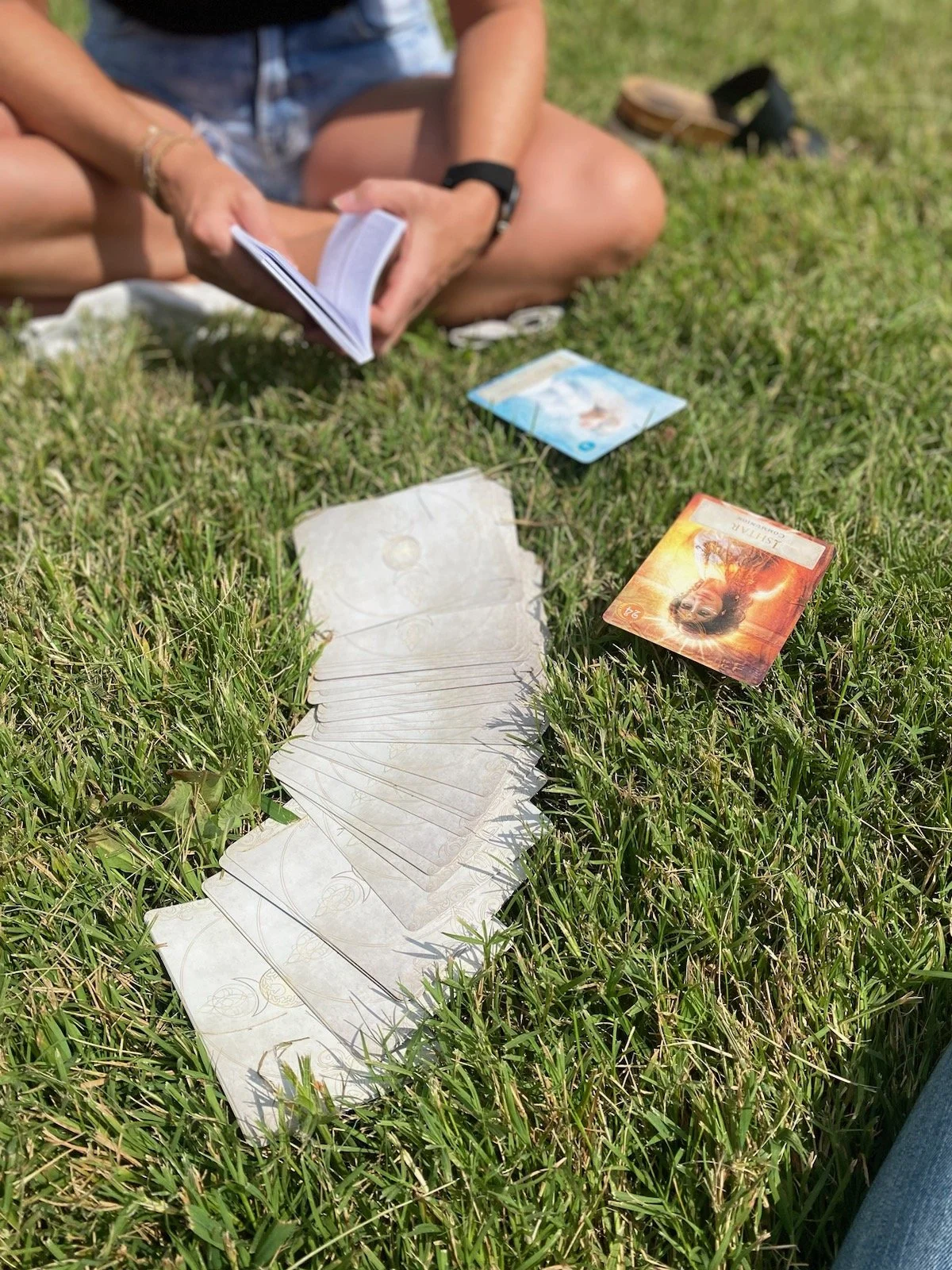
Recommended Reading & Listening
Want to go deeper? Here are some resources:
Books:
Siddhartha by Hermann Hesse
The story of a man who must shed every role, every teacher, and every idea of who he is supposed to be before he can finally bloom into his own understanding. What Siddhartha discovers at the river is not wisdom handed to him from outside. It is his own, arrived at through living. A beautiful companion to both Blooming and the year's larger arc.
Big Magic: Creative Living Beyond Fear by Elizabeth Gilbert
An invitation to live creatively, express boldly, and stop waiting until you feel ready. Gilbert writes about ideas as living things that want to come through us, and the cost of holding them back. For a month focused on letting what is alive in you come outward, this is the right book.
Untamed by Glennon Doyle
About unlearning who you were taught to be and stepping into who you actually are. One of the most honest books written in recent years about finding your voice, trusting it, and accepting the discomfort that comes with being fully seen. A Vishuddha book if there ever was one.
Present Over Perfect by Shauna Niequist
A quiet, personal book about trading the performance of a perfect life for the texture of a real one. Niequist writes directly to Santosha, the practice of finding that what is here is already enough, and the freedom that follows when you stop trying to earn your own contentment.
The Book of Awakening: Having the Life You Want by Being Present to the Life You Have by Mark Nepo
Daily meditations on opening, presence, and allowing. Nepo writes with great gentleness about the practice of being fully here, which is exactly what Blooming asks. Read one entry each morning. Let it set the tone.
Podcasts:
The Marie Forleo Podcast:Elizabeth Gilbert on Fear, Authenticity and Big Magic
On Being with Krista Trippet: Ross Gay - On the Insistence of Joy
Music has a way of reaching the places in us that are almost ready to open. This playlist is curated for June: songs that feel like something coming forward, like a window being opened, like permission. The kind of music that makes you want to say the thing you have been holding back.
A Note from Annie
Dear Friends~
We are halfway through this year together, and I have been thinking about what it means that you are still here.
You showed up in January with an intention. You stayed through February and March and April and May, doing the quiet work of becoming. And now it is June, and I want to tell you something honestly: I hope these guides have helped. I hope that somewhere in the reading, or in a practice, or in a single reflection prompt that caught you off guard, something shifted. I hope you feel even a little more ready to open than you did at the start of the year.
Because that is what I made them for.
What I did not expect was what making them would do to me.
Each month, I sit down to write these pages, and I find that I am not just teaching. I am expressing. I am putting into words things I believe deeply about this practice and this life, things I have been carrying for years, and finding that they are worth saying out loud. That process, the research, the writing, the choosing of what matters most, creating the playlist, has become one of the more creative and alive things I do.
I am blooming too, one guide at a time.
That is what this month is about for both of us, I think. Not a single dramatic opening, but the slow, ongoing practice of letting what is true in you come forward. A little more each month. A little more willing to be seen.
You have done five months of real work. You have roots now. You are nourished. There is something in you that is ready to come through.
I hope you let it.
With love,
Annie
P.S. If you have read this far and you are loving these guides, send me a text. It will make my whole day, and honestly, it will keep me going. (Studio text line: +1 641-925-3085
Welcome to June. Welcome to Blooming. What is ready to come through you is worth expressing.